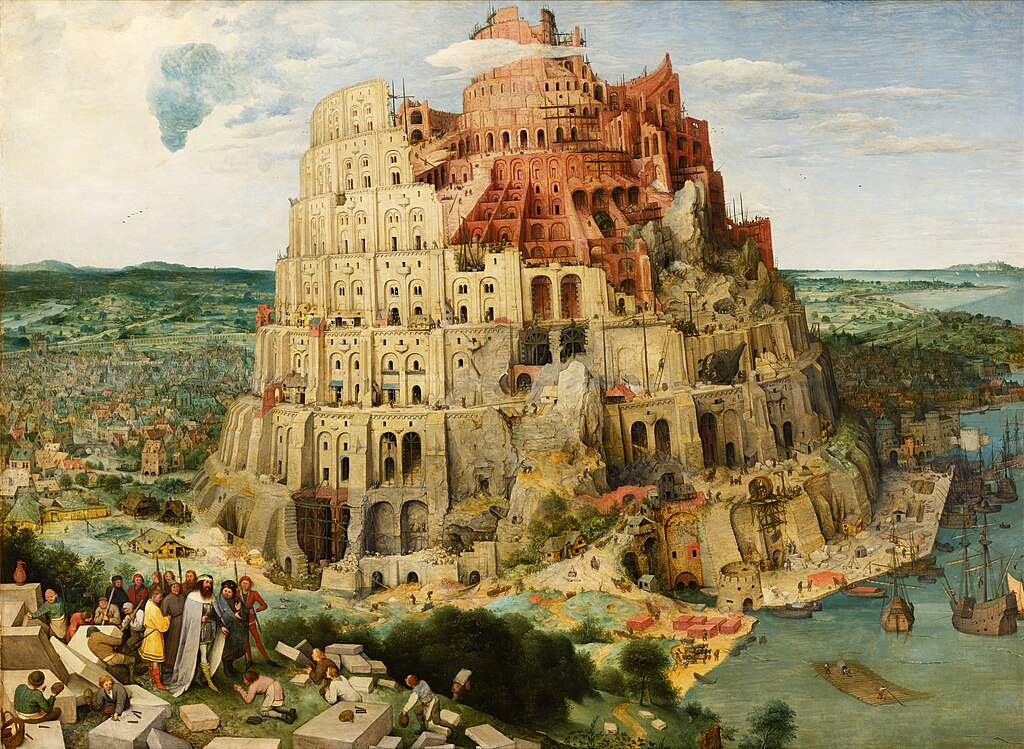
The Tower of Babel is an origin myth and parable in the Book of Genesis meant to explain the existence of different languages and cultures.
According to the story, a united human race speaking a single language migrates to Shinar (Lower Mesopotamia), where they agree to build a great city with a tower that would reach the sky. Yahweh, observing these efforts and remarking on humanity’s power in unity, confounds their speech so that they can no longer understand each other and scatters them around the world, leaving the city unfinished.
Some modern scholars have associated the Tower of Babel with known historical structures and accounts, particularly from ancient Mesopotamia. The most widely attributed inspiration is Etemenanki, a ziggurat dedicated to the god Marduk in Babylon, which in Hebrew was called Babel. A similar story is also found in the ancient Sumerian legend, Enmerkar and the Lord of Aratta, which describes events and locations in southern Mesopotamia.
The phrase “Tower of Babel” does not appear in Genesis nor elsewhere in the Bible; it is always “the city and the tower” or just “the city”. The original derivation of the name Babel, which is the Hebrew name for Babylon, is uncertain. The native Akkadian name of the city was Bāb-ilim, meaning “gate of God”. However, that form and interpretation itself are now usually thought to derive from Akkadian folk etymology applied to an earlier form of the name, Babilla, of unknown meaning and probably non-Semitic origin.
Per the story in Genesis, the city received the name “Babel” from the Hebrew verb bālal, meaning to jumble or to confuse, after Yahweh distorted the common language of humankind. According to Encyclopædia Britannica, this reflects word play due to the Hebrew terms for Babylon and “to confuse” having similar pronunciation.
 Pahnvir World